
The Church of Amwell
The Church of Amwell: A Forgotten Chapter in Deardurff Family History
The story of Anthony Dierdorf, the early German settlers of New Jersey, and the churches they helped establish nearly 300 years ago.
When researching your family history, you never know where an old name might lead you. Sometimes it is a birth record, a handwritten will, or an entry in a cemetery register. Other times, you discover that someone who shared your family name played a role in establishing a church that has survived for nearly three centuries.
That is what makes the history of the Church of Amwell in Hunterdon County, New Jersey, especially interesting to those of us researching the Deardurff family.
Long before the family name developed into spellings such as Deardurff, Deardorff, Deardorf, and Dearduff, historical records referred to members of the family as Dierdorf, Dierdorff, Derdorf, and Deerdorf.
One of those men was Anthony Dierdorf, also recorded as Antony Dierdorf or Dierdorff. His name appears in early church histories, property transactions, and accounts of the German settlers who helped establish religious congregations in colonial New Jersey.
His story gives us a fascinating look at the faith, hardships, and determination of some of the early German families in America.
German Settlers in Colonial New Jersey
During the late 1600s and early 1700s, German-speaking families began arriving in the American colonies in growing numbers. Many came through Pennsylvania before moving into neighboring New Jersey.
Some were looking for affordable farmland and better opportunities. Others were seeking freedom to practice their religious beliefs without the restrictions they had experienced in Europe.
Among these settlers were members of the German Baptist Brethren, a religious movement that began in Schwarzenau, Germany, in 1708 under the leadership of Alexander Mack.
The Brethren emphasized simple Christian living, adult baptism, peace, service to others, and the importance of following the teachings of Jesus Christ.
Their practice of baptism by immersion eventually earned them the nickname "Dunkards."
The Amwell area of Hunterdon County became home to several of these German-speaking families. By the early 1730s, they were ready to organize a congregation of their own.
And among the people who helped make that happen was Anthony Dierdorf.
The Founding of the Amwell Church of the Brethren in 1733
The history of the Amwell Church of the Brethren begins with a German minister named Johannes Naas, often called John Naas in American records.
Naas arrived in Philadelphia in September 1733. Word of his arrival soon reached German Brethren families already living in the Amwell area.
According to the history published by the Amwell Church of the Brethren, four men traveled to persuade Naas to come to New Jersey and serve as their minister.
Those four men were:
- Jacob Moore
- Antony Dierdorff
- Rudolph Herli
- John Peter Lausche
Naas accepted their invitation, and the congregation was organized before the end of 1733.
This makes Anthony Dierdorff one of the men directly associated with the founding of the Amwell Church of the Brethren.
There is an important historical detail worth mentioning. Some older church histories describe these men as arriving in Amwell with Naas in 1733. However, Hunterdon County historian Marfy Goodspeed, in her detailed research on the church, explains that Moore, Dierdorf, Harley, and Lawshe were already living in Amwell before Naas arrived.
Rather than arriving together as new settlers, the men appear to have traveled to Pennsylvania to recruit a minister for their growing community.
That makes Anthony's role especially meaningful. He was not simply someone who joined an established congregation. He was among the men who helped bring the congregation into existence.
A Name Found on an Early Deed
Anthony's involvement can also be found in an early land transaction.
In 1734, Jacob Moore sold 25 acres of land to Johannes Naas for £24. The property would become Naas' home for the remainder of his life.
According to Goodspeed's research, Antony Dirdorff was one of the witnesses to the deed, along with Benjamin Severns and Samuel Green.
The property was located along what is now known as Dunkard Church Road.
For family researchers, records like this are valuable because they place an individual in a particular community at a specific time, rather than relying entirely on family tradition.
Source: The Amwell Church of the Brethren, Marfy Goodspeed, March 18, 2016
Worship Before There Was a Church Building
One of the interesting things about the early Amwell congregation is that it existed for many decades without a dedicated church building.
The congregation was formed in 1733, but its first meetinghouse was not built until 1811.
For much of those early years, families gathered in one another's homes for worship, prayer, fellowship, and communion.
Imagine what those gatherings may have been like. Families traveled along rough colonial roads, sometimes over considerable distances, to gather with neighbors who shared their faith.
Their homes became places of worship, and their community became the church long before there was a church building.
By 1790, historical reports recorded 46 baptized members in 28 families associated with the congregation. That may seem small by today's standards, but the congregation had already survived the passing of its founding minister and the movement of families into newer settlements.
Johannes Naas died on May 12, 1741, yet the congregation he helped establish continued.
The Amwell Church of the Brethren remains an important part of New Jersey's religious history.
Other Dierdorf Family Members in the Early Church
Anthony was not the only person carrying the Dierdorf name who appears in the church's early history.
Alexander Mack Jr., the son of the founder of the German Baptist Brethren movement, compiled a historical list of early church members who had died.
That list, reproduced in Marfy Goodspeed's research, includes:
- Antony Dierdorf and his wife Christina
- Peter Dierdorf
- Henrich Dierdorf and his wife Anna
These names suggest that the Dierdorf family's connection with the Amwell congregation extended beyond one individual.
It is important, however, not to assume exact family relationships simply because the names appear together. Determining whether Peter and Henrich were sons, brothers, or otherwise related to Anthony requires additional genealogical documentation.
What the historical account does establish is that several people carrying the Dierdorf surname were remembered among the early members of the congregation.
For descendants researching the family, that is an important starting point.
Another Amwell Church and an Important Land Connection
 The history becomes even more interesting when we look at a second church in the Amwell area.
In 1749, a German Reformed congregation established a church near what is now Ringoes, New Jersey.
This congregation was different from the Amwell Church of the Brethren. The German Reformed church followed the Calvinist religious tradition, while the Brethren had developed from the German Anabaptist and Pietist movements.
However, the two congregations shared something important in their early history: the name Anthony Dierdorf.
In Theodore Frelinghuysen Chambers' 1895 book, The Early Germans of New Jersey: Their History, Churches, and Genealogies, the author discusses the founding of the German Reformed church at Amwell.
According to Chambers, the church was dedicated on December 1, 1749.
The deed for the property was dated January 21, 1749, and the land had previously belonged to Anthony Dierdorf, who had purchased it from Nathan Allen.
The property was conveyed to three trustees, William Kase, Peter Hofman, and William Bellowsfelt, acting on behalf of the German Reformed congregation.
This is a remarkable detail.
Not only does Anthony appear in the history of the Brethren church founded in 1733, but his name is also connected to the land used by another early German congregation sixteen years later.
The property record itself does not tell us why the land changed hands or establish that Anthony was a member of the Reformed congregation. Nevertheless, it demonstrates how closely his name was connected with the German settlement of the Amwell area.
Source: The Early Germans of New Jersey, Theodore Frelinghuysen Chambers, 1895
The Church, the Cemetery, and the Historical Marker
Today, a historical marker near Ringoes identifies the United First Presbyterian Church of Amwell.
The marker explains that the congregation was founded as a German Reformed church in 1749 by German settlers from the Palatinate region.
It also notes that the original stone church stood in what is now the adjoining cemetery. The congregation became Presbyterian in 1810.
This is the church connected to the 1749 land history described by Chambers.
The marker stands near the intersection of Old York Road and Dutch Lane in East Amwell Township.
For anyone interested in visiting the area, the marker offers a physical connection to the history recorded nearly three centuries ago.
There is something meaningful about standing where an early church once stood and realizing that the land itself has a documented connection to a family name you are researching.
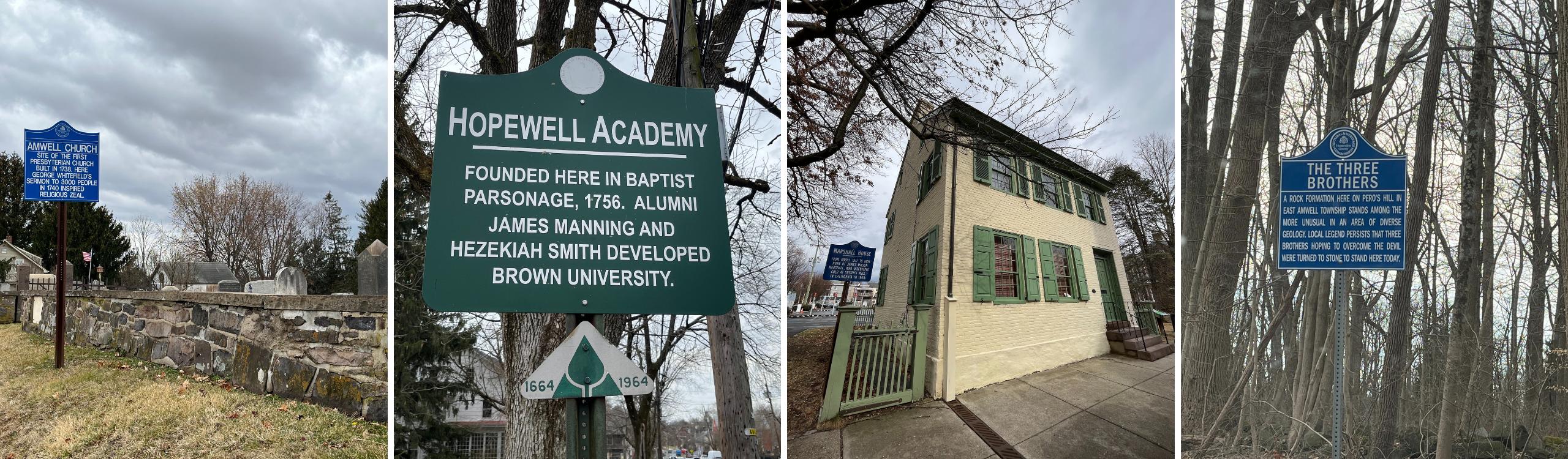
Source: United First Presbyterian Church of Amwell, Historical Marker Database
What About the Early Dierdorf Graves?
The cemetery history raises another question: Where were Anthony Dierdorf and the other early members of the family buried?
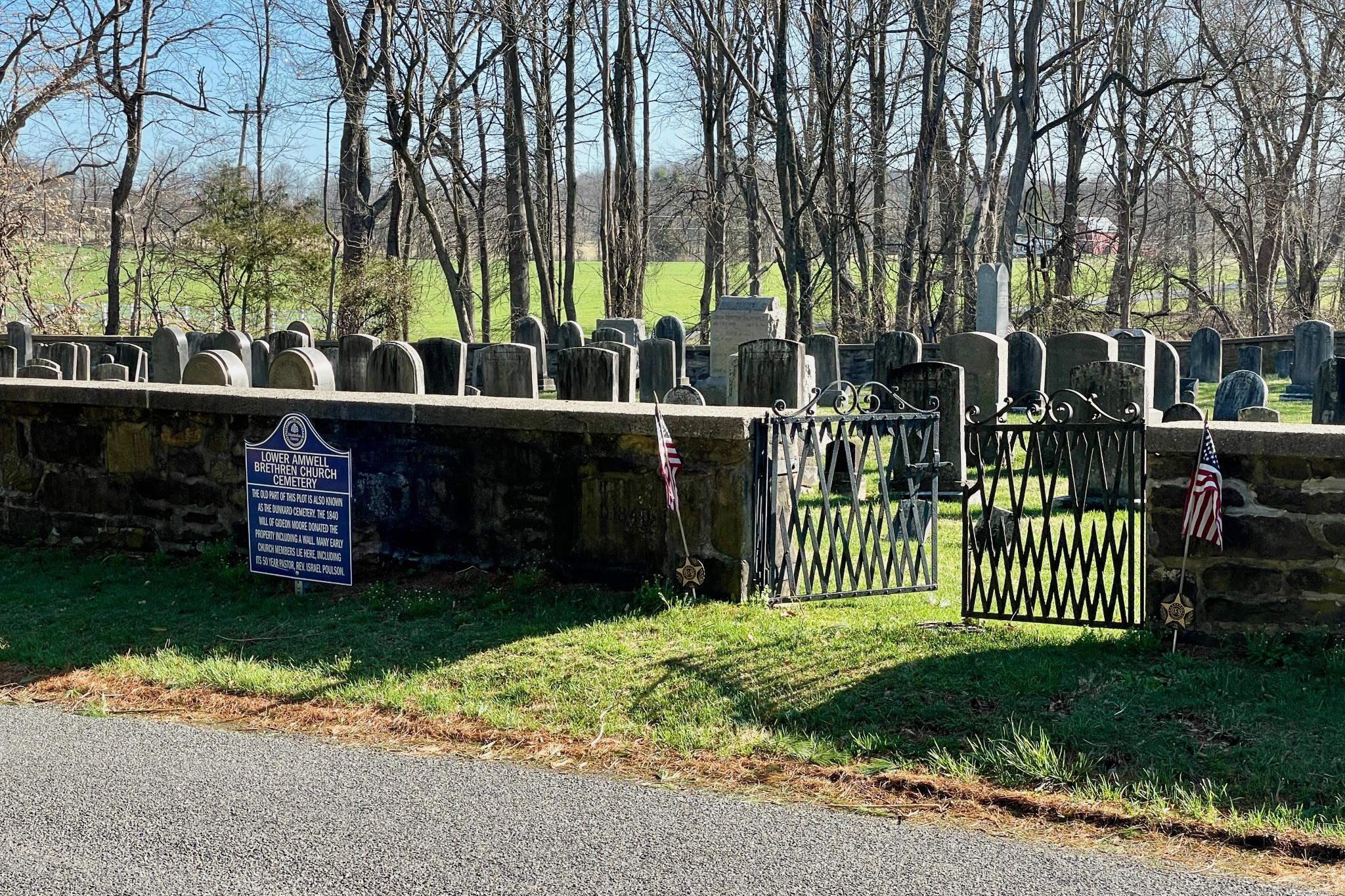 The Amwell Church of the Brethren also has historic burial grounds associated with its congregation, including the Lower Amwell Cemetery and the older Moore burial ground.
Historical accounts suggest that Johannes Naas was buried in the Moore Cemetery, although his original gravestone has not survived.
The early list compiled by Alexander Mack Jr. confirms that Anthony, Christina, Peter, Henrich, and Anna Dierdorf were remembered among deceased members of the Brethren congregation.
However, the list does not establish their burial locations.
At present, I have not found sufficient evidence to identify a particular grave or surviving headstone for Anthony Dierdorf.
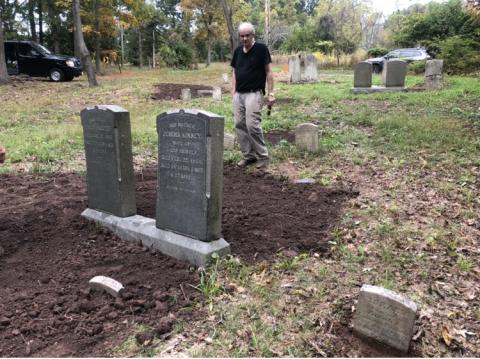 The cemetery adjoining the former German Reformed church and the burial grounds associated with the Brethren congregation are separate historical sites. It would be a mistake to assume that Anthony or his family members were buried in one simply because his name appears in the church's history.
That is an area where additional cemetery surveys, burial registers, early wills, and local historical records might eventually provide answers.
Source: The German Baptist Church in Amwell, Goodspeed Histories
Why This History Matters to the Deardurff Family
One of the challenges of researching the Deardurff family is following the name through centuries of different spellings.
The name found in early American records may appear as Dierdorf, Dierdorff, Derdorf, Deerdorf, or Dirdorff. Later records include variations such as Deardorf, Deardorff, Dearduff, and Deardurff.
These spelling differences can make it difficult to recognize family connections, especially when searching old books, church records, and handwritten documents.
The Amwell records give us several valuable pieces of documented history.
They establish that Anthony Dierdorf was associated with the formation of a Brethren congregation in 1733. They place him at a property transaction involving Johannes Naas in 1734. They connect land formerly owned by him to the German Reformed church founded in 1749. And they preserve the names of several other Dierdorf family members associated with the early Brethren congregation.
There are still unanswered questions about family relationships, exact burial locations, and how each branch of the Dierdorf family connects to later generations.
But these records give us something solid to build upon.
Nearly 300 Years of History
When I look at the history of the Amwell churches, what stands out is how much of our early family story is tied to ordinary people building something for their communities.
 They purchased land, raised families, gathered in homes to worship, and helped establish congregations that became part of the American landscape.
The names recorded in these old histories were once living people making decisions about where to settle, how to practice their faith, and what kind of community they wanted to create.
Nearly 300 years later, we are still uncovering their stories.
For those of us carrying the Deardurff name, or one of its many variations, the records surrounding Anthony Dierdorf and the churches of Amwell offer another piece of a much larger family puzzle.
And perhaps somewhere in an old cemetery register, a forgotten land deed, or a handwritten family Bible, there are still more pieces waiting to be found.
Historical Sources and Further Reading
- Amwell Church of the Brethren. History of the Amwell Congregation. The congregation's own history, including Anthony Dierdorff and the organization of the church in 1733.
- Goodspeed, Marfy. The Amwell Church of the Brethren, March 18, 2016. Historical research into the congregation, its founding members, early deeds, and the Dierdorf family.
- Chambers, Theodore Frelinghuysen. The Early Germans of New Jersey: Their History, Churches, and Genealogies, 1895. Includes information about the founding of the German Reformed church and the land formerly belonging to Anthony Dierdorf.
- Historical Marker Database. United First Presbyterian Church of Amwell. Documents the 1749 German Reformed church, its historic cemetery, and its later transition to a Presbyterian congregation.
- Goodspeed, Marfy. The German Baptist Church in Amwell. Historical accounts of the Brethren congregation and associated burial grounds.
- National Register of Historic Places. German Valley Historic District. Background information on another early German settlement in New Jersey, located in Morris County rather than Amwell.
Research note: This article is based on available church histories, published historical research, and surviving references to early land records. While the Dierdorf surname is documented in the Amwell congregations, individual family relationships and burial locations require further verification. Additional records and corrections are welcome as this family history continues to develop.