
Before We Were Deardurffs:
The History of Dierdorf, Germany
Tracing our family name back to a German town with more than 900 years of history.
I’ve spent quite a bit of time researching the Deardurff family name and its variations. Deardorff, Deardorf, Dearduff, Dierdorf, and a few others have shown up along the way. Sometimes I wonder whether the people keeping those old records were guessing at the spelling as much as I am trying to figure it out today.
One name that keeps coming up is Dierdorf, a small town in western Germany, northeast of Koblenz, in what is now the state of Rhineland-Palatinate.
I knew there was a connection between the name and the town, but what I hadn’t fully appreciated was just how far back the town’s history goes.
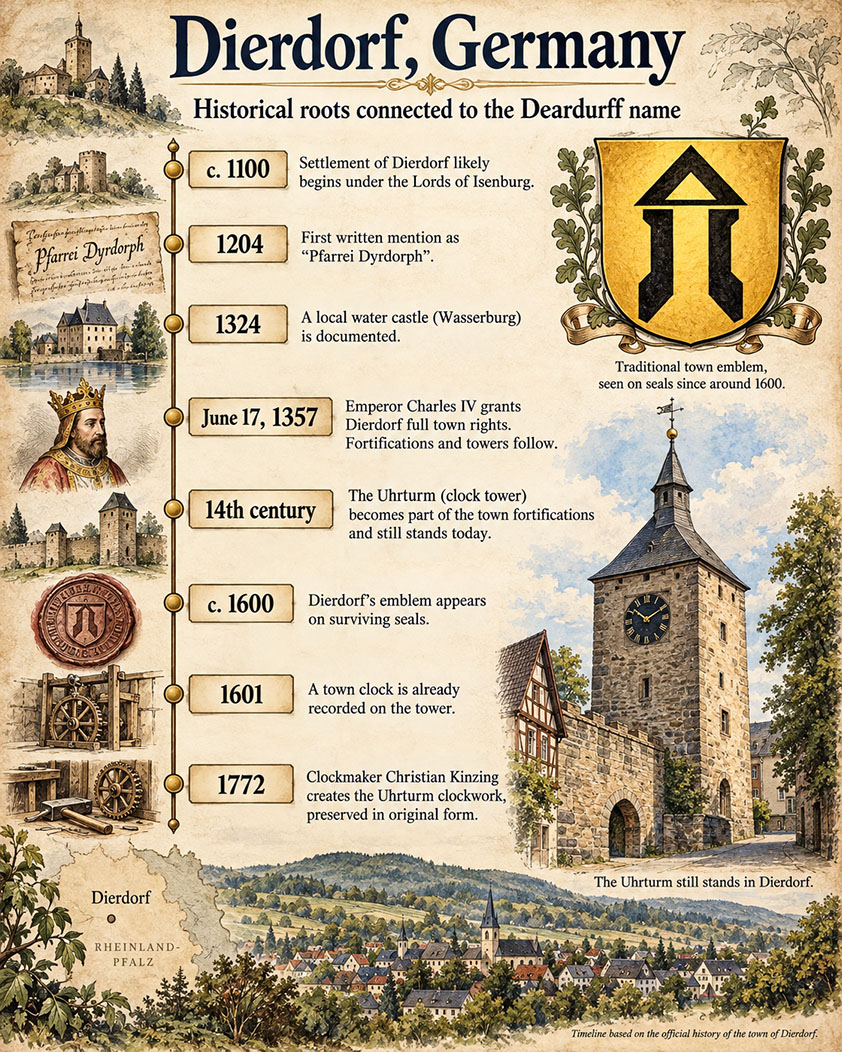
As it turns out, we can trace the written history of Dierdorf all the way back to 1204. And historians believe the settlement may have existed a century before that.
That’s more than 900 years of history to explore.
A Little Town Called Dyrdorph
The earliest known written reference to Dierdorf comes from 1204, when the settlement was recorded as Pfarrei Dyrdorph, or the parish of Dyrdorph.
This is significant because the town was already an established religious community at the time. It wasn’t simply a handful of houses that somebody decided to name. It had a parish, surrounding lands, and connections to the ruling families of the region.
According to the town’s official historical information, the settlement’s beginnings date to around 1100, when the Lords of Isenburg were active in the area.
Of course, the exact founding date is difficult to establish. The year 1204 gives us a documented starting point, but the town’s existence almost certainly began earlier.
In fact, historical research published by the Göttingen Academy of Sciences and Humanities confirms that Dierdorf was already the center of a church parish when it first appeared in written records.
And that’s what makes this interesting to me. We aren’t talking about some settlement founded a few decades before our ancestors sailed to America. We’re looking at a community that had already existed for hundreds of years before Europeans began settling what would become the United States.
Castles, Town Walls, and a Medieval Clock Tower
By 1324, historical records mention a castle at Dierdorf, associated with the noble families who controlled the surrounding region.
It was a Wasserburg, or water castle, a type of fortified residence commonly protected by water or a moat.
The historical research on Dierdorf explains that the castle was built by the Lords of Isenburg-Braunsberg before 1324. Today, an island in the former castle pond remains as evidence of where the medieval fortress once stood.
Then, on June 17, 1357, Emperor Charles IV granted Dierdorf town rights.
Interestingly, Dierdorf had also been included in an earlier imperial document granting town privileges in 1346. The 1357 grant is the date traditionally recognized in the town’s official history.
These privileges helped establish Dierdorf as a recognized town, with protections and fortifications that included a town wall and defensive towers.
Some of those medieval structures are still standing today.
One is the Uhrturm, or Clock Tower, originally part of the town’s defensive system. Another is the Eulenturm, sometimes called the Owl Tower.
According to the City of Dierdorf’s official description of its historic towers, the Uhrturm was originally part of the 14th-century fortifications. A clock was already installed there by 1601, and in 1772, clockmaker Christian Kinzing of Neuwied created a new clock mechanism that has survived to the present day.
Imagine that for a moment. Structures that were part of the town’s defenses more than 600 years ago can still be seen today.
There’s another interesting piece of history here. In 1902, Dierdorf’s old palace was demolished, and stones from the building were reused in constructing the town’s Protestant church in 1903 and 1904.
Even when parts of the town disappeared, their materials became part of something new.
How Did Dierdorf Become Deardurff?
This is where the town’s history starts to connect with my family research.
The Dictionary of American Family Names, published by Oxford University Press, identifies Deardurff as an Americanized version of the German surname Dierdorf.
The dictionary also identifies Deardorff as a variation of Dierdorf, a surname associated with the town near Koblenz.
The spelling variations are fascinating. The town itself appeared in historical records under names such as Dyrdorph, and related family records contain spellings including Dierdorf, Dierdorff, Dirdorff, Deardorff, and Deardurff.
When German families immigrated to America, their names often changed. Sometimes the changes came from pronunciation, sometimes from spelling conventions, and sometimes from clerks recording a name as they understood it.
I’ve been trying to track down a family story suggesting that our surname changed because of a military registration, possibly during the Civil War.
That story may have some truth to it, but I’ve also found records suggesting that the spelling was in use much earlier.
An index of the 1790 United States Census for Huntingdon County, Pennsylvania, lists an Abraham Deardurff on page 111, line 3.
Interestingly, my own family research traces our lineage through an Abraham Deardurff who lived from 1758 to 1816.
Could these be the same man?
Possibly. The name, time period, and location make it worth investigating. But I’d want to examine the original handwritten census record and compare it with other family documents before drawing that conclusion.
Another census transcription from Putnam County, Ohio, in 1840 lists a John Deardurff, again using our modern spelling.
Both records predate the Civil War, which makes me wonder whether the family story might actually refer to the Revolutionary War or another event during the early years of America.
Or perhaps the spelling changed more than once, among different branches of the family.
That is one of the things I hope to establish as I continue digging through the records.
From Germany to Colonial America
Another part of this investigation has taken me to the Amwell Church of the Brethren in Hunterdon County, New Jersey.
Historical records from the church identify a man named Antony Dierdorff as one of the early German settlers who helped organize the congregation in 1733.
According to the Amwell Church’s own historical account, Antony was among four men who approached John Naas, who had recently arrived in Philadelphia, and persuaded him to become their pastor.
Additional historical research published by Goodspeed Histories identifies Antony under the spelling Dirdorff as a witness to a 1734 property transaction involving Jacob Moor and Johannes Naas.
These records establish that people carrying variations of the Dierdorf name were present in colonial America long before the Revolutionary War.
My own Ancestry research traces my family line through Anthony Tunis Dierdorff (1655–1745), Anthony Dierdorff (1683–1745), Heinrich Dierdorff (1707–1749), and Abraham Dierdorff (1730–1801).
The names and dates are especially interesting when compared with these early church and colonial records. However, connecting individuals across historical documents takes more than finding a matching name.
I want to continue verifying these relationships with original records wherever possible rather than relying entirely on information passed from one family tree to another.
A Family Name With a Long History
One thing I’ve learned while researching family history is that every answer seems to lead to three more questions.
Where did our earliest identifiable ancestors live? When did they leave Germany? Which families settled in Pennsylvania and New Jersey, and which branches eventually moved west into Ohio, Indiana, and beyond?
And at what point did the spelling of our particular family name become Deardurff?
I don’t have all those answers yet.
But knowing that Dierdorf was already an established German community in 1204 gives me a much better place to begin.
The town has survived wars, fires, political changes, and more than nine centuries of history. Meanwhile, its name has apparently traveled across an ocean, appearing in American records under several different spellings.
For me, that’s a fascinating part of our family heritage, and one worth continuing to explore.
Sources and Historical References
The following sources were used in researching this article. Some provide official historical information about Dierdorf, Germany, while others document the appearance of related family names in early American records.
1. Verbandsgemeinde Dierdorf. “Wissenswertes über die Stadt Dierdorf.”
Official municipal history of Dierdorf, covering the town’s beginnings around 1100, its first documented mention in 1204, medieval fortifications, surviving historical buildings, and later developments.
2. Friedhoff, Jens. “Dierdorf.” Residenzstädte im Alten Reich (1300–1800), 2022, pages 174–177.
An academic historical study published through the Göttingen Academy of Sciences and Humanities. Covers Dierdorf’s medieval political history, castle, town privileges, and development as a regional administrative center.
Read Academic Historical Research
3. Stadt Dierdorf. “Uhrenturm / Eulenturm.”
Official information about Dierdorf’s surviving medieval towers, including the Uhrturm’s history, the town clock first recorded in 1601, and Christian Kinzing’s 1772 clock mechanism.
View Historic Tower Information
4. Hanks, Patrick, editor. Dictionary of American Family Names, Second Edition. Oxford University Press, 2022.
Surname reference identifying Deardurff and Deardorff as Americanized forms of the German Dierdorf surname.
Deardurff Surname Origin | Deardorff Surname Origin
5. Amwell Church of the Brethren. “A Brief History of the Amwell Church.”
Church history documenting the congregation’s establishment in 1733 and naming Antony Dierdorff among the early German settlers involved.
6. Goodspeed Histories. “The Amwell Church of the Brethren.”
Historical research describing the founding of the congregation, early members, and a 1734 property transaction witnessed by Antony Dirdorff.
7. The USGenWeb Census Project. “Huntingdon County, Pennsylvania, 1790 Federal Census Index.”
Transcribed census index identifying Abraham Deardurff on page 111, line 3. The original handwritten record and the individual’s genealogical identity require further verification.
8. Genealogy Trails History Group. “Putnam County, Ohio, 1840 United States Federal Census.”
Transcribed census information containing an entry for John Deardurff in Ottawa Township, Ohio. Original census records should be consulted to confirm the spelling.
View the 1840 Census Transcription
A Note About This Research
This article is part of my ongoing research into the Deardurff family and related surname variations. Historical information about Dierdorf is drawn from municipal and academic sources. Family relationships and surname transitions are based on genealogical research, including my personal family tree, and may be updated as additional records become available.
If you have historical documents, photographs, family records, or information about the Deardurff, Deardorff, Deardorf, Dearduff, or Dierdorf families, I’d welcome the opportunity to learn more.